Prayer to mary of knots: essential, practical guide in 7 steps
Understanding the prayer to mary of knots: meaning, history, and how to pray
The prayer to mary of knots is a popular devotion for people who feel tangled in life’s problems — those complex situations that do not yield to quick fixes, from family conflict and financial anxiety to lingering guilt and spiritual discouragement. Rooted in a much older Christian image of Mary “undoing” the knot of human disobedience, the devotion invites you to bring your “knots” honestly to God, asking Mary’s help to loosen them with patience, hope, and practical wisdom.
At heart, the prayer to mary of knots is simple: you name your knot, ask for Mary’s intercession, and trust that God is at work even when the situation still feels tight. Many people also practise a structured novena over nine days, or include the devotion within the Rosary. The language is gentle and accessible, making it a prayer for everyday life rather than only for extraordinary moments.
In the pages below, you will find the background of the devotion, how to pray in a way that suits your schedule, common mistakes to avoid, and practical tips to help you persevere. Whether you are new to Marian prayer or returning to it after a long time, the prayer to mary of knots offers a way to move forward one patient step at a time.
Why the prayer to mary of knots resonates today
Modern life creates “knots” of a particular kind: packed diaries, fractured relationships, online pressures, and silent worries that keep us awake. The prayer to mary of knots gives people language to bring those knots into the light, to ask for help, and to proceed with peace rather than panic. It does not promise instant results; instead, it cultivates trust, the steady habit of returning to God, and the humility to accept help.


Another reason the devotion travels so well is its symbolism. Everyone understands a knot. It is stubborn, sometimes self-made, and deceptively small. A knot can ruin a whole cord or bow until someone patiently loosens it. In that image, many find courage to keep going, and the prayer to mary of knots becomes a daily practice rather than a last resort.
Origins and symbolism behind Mary, Undoer of Knots
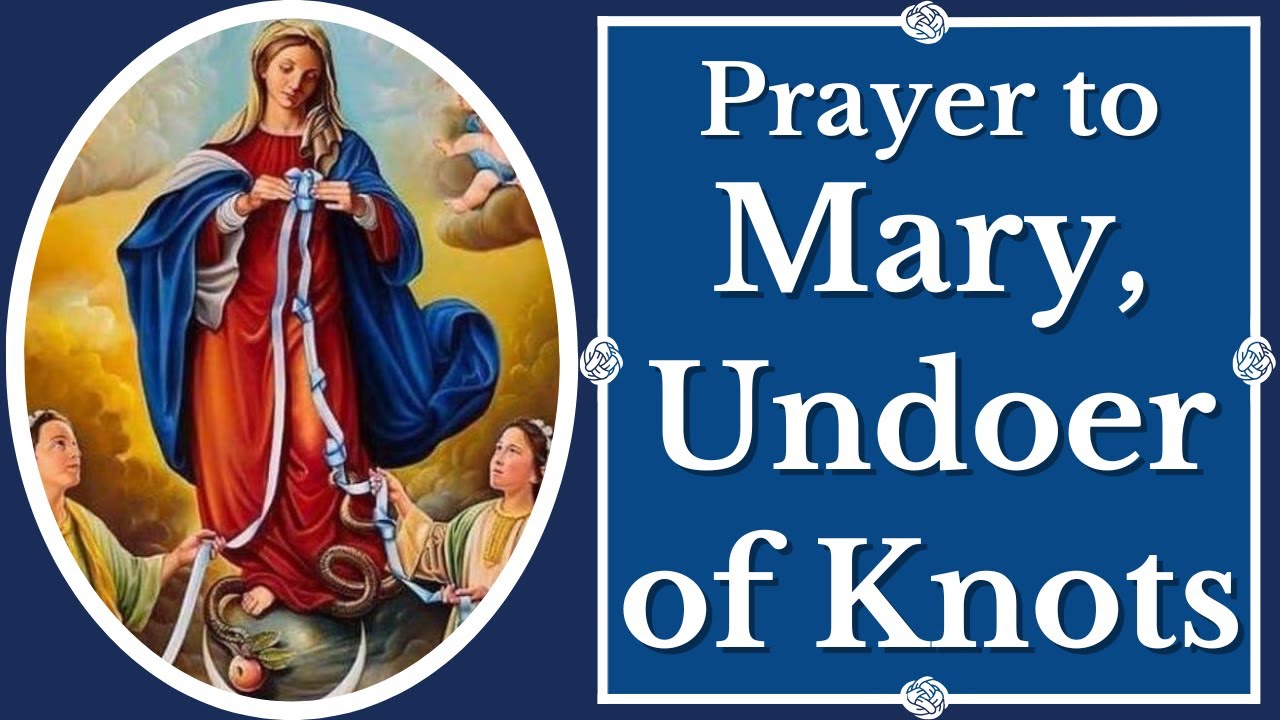
The devotion comes from a Baroque painting (c. 1700) by Johann Georg Melchior Schmidtner in Augsburg, Germany. It portrays Mary gently untying knots in a long ribbon, assisted by angels, with the Holy Spirit above. The image echoes an early Christian theme from St Irenaeus: the knot tied by Eve’s disobedience was loosened by Mary’s obedience. You can read a succinct background in the Wikipedia overview of Mary, Undoer of Knots, which traces how the icon inspired prayer practices over time.
In the late twentieth century, the devotion gained global attention through the ministry of Pope Francis, who encountered the painting while studying in Germany and helped to popularise the image and its prayer in Argentina and beyond. For a snapshot of this modern history, see Vatican News: Pope Francis and Our Lady Undoer of Knots. This recent prominence has helped many discover that the prayer to mary of knots is not a “new trend” but an accessible doorway into ancient Christian hope.
How to pray the prayer to mary of knots: a simple guide
You can pray in many ways: standing at a bus stop, in a quiet corner at home, or during a walk. The steps below are a gentle framework. Feel free to adapt them to your day and to your faith tradition.
Prepare your space and intention
- Choose a quiet moment. A few deep breaths can help you arrive in the present.
- Name your “knot”. Be specific: “I am stuck in resentment toward my colleague,” or “I feel paralysed by this debt.” Clarity helps the prayer to mary of knots move from vague worry to honest conversation.
- If you have one, place an image of Mary, Undoer of Knots nearby. Some people keep a ribbon with a small knot as a visual reminder.
A short daily prayer to mary of knots
Here is a simple, original prayer you can use. Adjust the words to fit your situation:
“Mary, Undoer of Knots, I bring you this knot in my life: [name it simply]. In your patience and faith, intercede for me before God. Help me to see what I can do today, to trust what I cannot see, and to wait with hope while this knot is untied. Amen.”
Say the prayer to mary of knots once in the morning, and if you wish, again in the evening. You might add a short “thank you” each time you notice a small step forward.
A nine-day novena: prayer to mary of knots in depth
If you wish to go deeper, a novena spreads the prayer over nine days. This structure is traditional yet adaptable. The prayer to mary of knots in novena form is not about “unlocking” a result by day nine; it is about steady trust.
- Begin each day with the Sign of the Cross (if familiar) and a moment of silence.
- State your intention clearly — the knot you seek to have loosened.
- Pray a decade of the Rosary (one Our Father, ten Hail Marys, one Glory Be). If you are not used to the Rosary, a simple “Hail Mary” repeated slowly is sufficient. The CBCEW: What is the Rosary? guide offers a quick refresher.
- Use a set prayer or speak from the heart. Many published versions exist; for a fully written novena text, see the Loyola Press novena to Mary, Undoer of Knots.
- End with a brief act of trust: “Mary, I place this knot in your hands.” Sit in silence for half a minute before moving on with your day.
Tip: Keep a tiny notebook. Each day, jot down any sign of movement — a softened mood, a helpful idea, a chance conversation. The prayer to mary of knots often loosens what we feel inside before anything outside changes.
A practical example: bringing one knot to prayer
Imagine you feel stuck in a strained family relationship. Day one: you name the knot and ask for Mary’s help. Day two: you realise you have not apologised for a harsh comment. Day three: you sense the courage to apologise. Day four: you write a draft message and ask a friend to read it. Day five: you send it, without demanding a reply. Day six: you feel calmer, even though no response has arrived. Day seven: you remember to pray for the other person, not merely for a result. Day eight: a brief, polite response comes; it’s not everything, but it’s something. Day nine: you thank God for partial healing and ask for the next step. Here the prayer to mary of knots has worked not by magic but by patience and grace.
When to use the prayer to mary of knots
There is no wrong time. People turn to the prayer to mary of knots when they face complicated decisions, persistent habits, difficult colleagues, legal or financial tangles, and spiritual dryness. It is also suitable for times of gratitude: one knot has loosened, and you pray to remain steady as you move forward.
Some choose a weekly rhythm: a short form most days, with the novena structure once a month or during especially tangled seasons. Others incorporate a single line into the Rosary. Whatever your pattern, let the prayer to mary of knots draw you away from frantic fixing and toward faithful action.
Beyond words: gestures and symbols that help
Many find that a small, physical sign keeps the heart engaged. Consider these options:
- A ribbon with a simple knot. Hold it while you pray. When your situation genuinely shifts, untie it slowly as a sign of thanks.
- A candle lit for a short time each day. Extinguish it as a sign of entrusting the knot into God’s care.
- A written intention placed near a devotional image. Review it weekly so the prayer to mary of knots remains concrete and honest.
How this devotion sits with other Christian practices
The prayer to mary of knots works well alongside Scripture reading, the Rosary, Eucharistic prayer, and ordinary acts of charity. If you are developing a habit of daily prayer, you might value an exploration of the meaning of “pray without ceasing” to see how short, repeated prayers can quietly shape your day. If your knot includes regret or fault, pairing the devotion with an honest examination of conscience and steps toward reconciliation — see this guide on how to repent for your sins — can deepen its fruitfulness.
Common mistakes and gentle corrections
- Treating it like a transaction. Prayer is relationship, not a vending machine. The prayer to mary of knots invites patience, not a guaranteed timeline.
- Hiding the real knot. Sometimes we pray around the edges. Be specific and truthful, even if your knot includes your own mistakes.
- Neglecting action. While you pray, ask, “What small step can I take today?” Grace often meets us mid-step.
- Going it alone. Share your intention with someone you trust. Community can hold hope when your energy dips.
- Ignoring practical support. Prayer and professional help are allies, not rivals. If your knot involves health, safety, or legal issues, seek appropriate advice.
How to evaluate progress without pressure
Not all knots come loose in obvious ways. Look for quiet signs: you sleep better, your words soften, you can wait without bitterness, a new option appears. Record these signs weekly. When you practise the prayer to mary of knots in this reflective way, you notice both interior and exterior shifts, and you are less likely to give up when the outcome takes time.
Praying with others: families, friends, and parish groups
Some knots belong to more than one person — family tensions, team conflicts, or shared grief. Consider a modest group practice. Keep it simple: choose one shared intention, agree on a short form of the prayer to mary of knots, and check in weekly. The goal is not forced disclosure but mutual support. If your group prays the Rosary, you can add a brief intention at the start of a decade and end with, “Mary, Undoer of Knots, pray for us.”
Safeguarding your heart: hope without denial
Hope is different from denial. The prayer to mary of knots asks for healing without pretending that pain is small. You can hold both truths: “This is hard” and “God is faithful.” Bringing both to prayer often opens space for compassion — for yourself and for others — which itself loosens many everyday knots.
Related articles
Recommended external resources
- Background and history of Mary, Undoer of Knots (Wikipedia)
- Pope Francis and the Undoer of Knots devotion (Vatican News)
- Full text of a nine-day novena (Loyola Press)
- Overview of Marian devotions (USCCB)
Frequently asked questions about prayer to mary of knots
Is the prayer to mary of knots only for Catholics?
No. While the devotion has Catholic roots and imagery, its heart — asking Mary to pray with us as we bring our knots to God — is accessible to many Christians who honour Mary as Jesus’ mother and a model disciple. If Marian prayer is unfamiliar to you, you can adapt the words so they express your faith comfortably.
Do I need a specific, official text to pray it “properly”?
No single text is mandatory. Many versions exist, including formal novena prayers, but the essential movement is the same: name the knot, ask Mary’s intercession, trust God, and take small steps. If you prefer a written form, the curated novena at Loyola Press is a good starting place. Otherwise, the simplest prayer to mary of knots can be entirely in your own words.
What if my situation gets worse while I’m praying?
This can happen. Prayer does not shield us from every difficulty; it gives us strength to walk through it. Keep going. Ask for help from trusted people, and consider whether a new practical step is needed. The core of the prayer to mary of knots is perseverance and trust, not instant change.
